
The sport of wingfoiling
What is Wingfoiling?
Wingfoiling is an individual recreational wind sport conducted on open water, ideally in winds of 12–30 knots. It can be performed on flat or choppy water and is increasingly practised on oceans, bays, lakes, and estuaries — basically, if there’s water and wind, someone’s probably tried wingfoiling on it. The wingfoiler uses a hand-held inflatable wing to generate power, propelling themselves across the water on a board, often fitted with a hydrofoil. The sport follows the same aerodynamic and hydrodynamic principles as sailing — minus the boat, the rigging, and most of the dignity during your first few sessions.

The sport spans several disciplines — freeriding, wave-riding, freestyle, downwind riding, and course racing — so there’s a flavour for every personality type, from “I just want to cruise” to “I want to fly off a wave and question my life choices mid-air.” A large part of wingfoiling involves using the wing to generate power while balancing and manoeuvring on a hydrofoil board raised above the water. Direction of travel follows the same basic principles as sailing, even if it doesn’t always feel that intuitive when you’re still figuring out which way is “upwind.”
The wingfoiler is the direct link between wing and board, as the wing is hand-held rather than fixed to the rider or board — meaning you, and only you, are responsible for not letting go of either. Depending on discipline and riding style, the rider may wear a waist leash or harness. The wing is typically secured via a wrist leash, and the board via a board leash, because gear has a habit of wandering off without you.
Skills Required
The primary skill is learning to control and position the wing to generate and regulate power. Once that’s mastered, the board and hydrofoil are introduced, requiring the rider to balance, steer, and manage power all at once to rise onto the foil and ride efficiently — no pressure.
Riders must continuously adjust wing position, body weight, and board trim to maintain stable flight, a combination of wind awareness, balance, coordination, and board control that some days feels less like a sport and more like a very wet juggling act.
From there, riders progress to foiling, wave-riding, jumping, freestyle, and downwind riding. As with most board sports, the skill ceiling keeps rising as the sport evolves — just when you think you’ve got it figured out, someone invents a new trick to humble you.
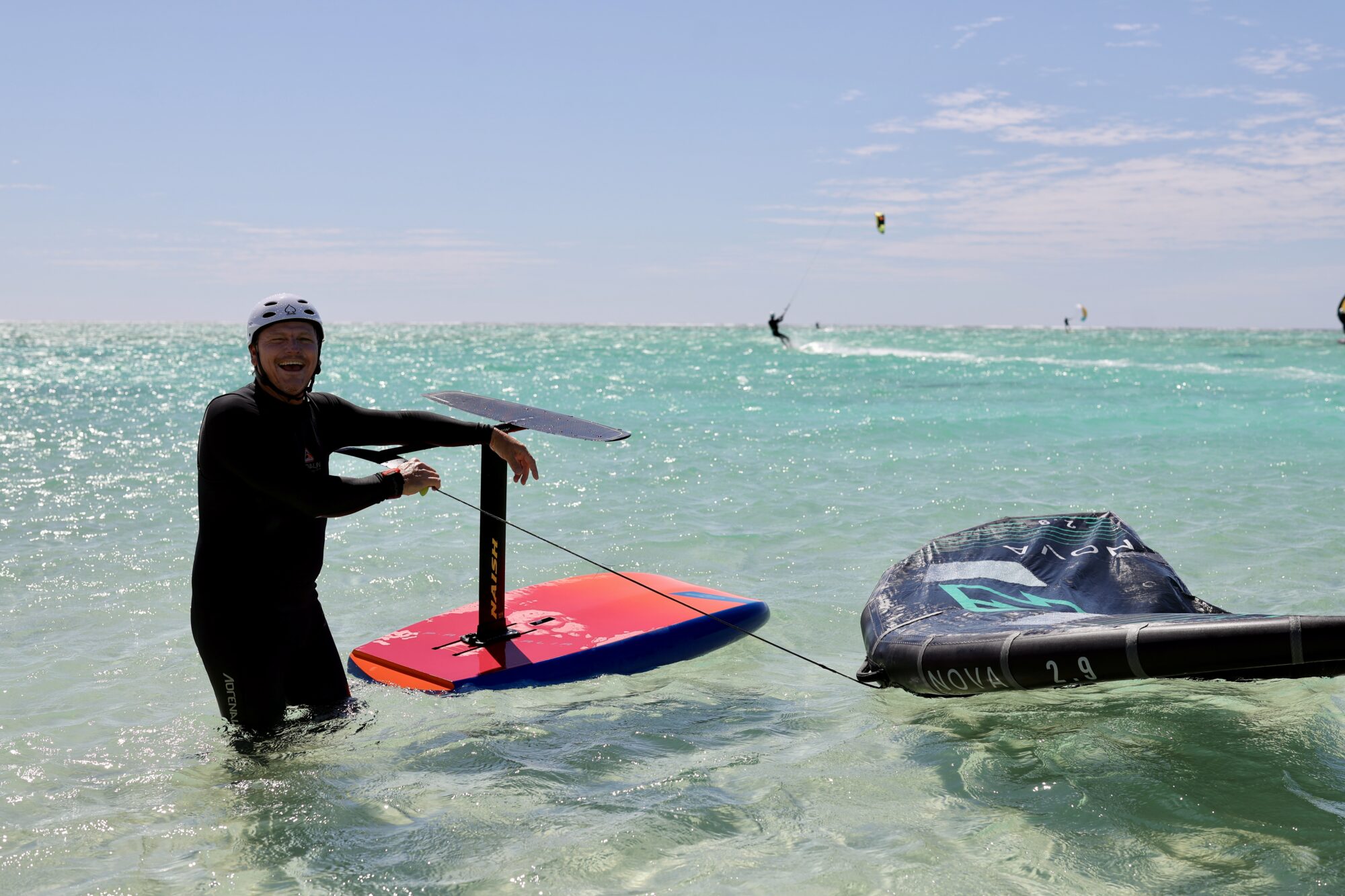
Equipment
Essential gear includes a wing, board, hydrofoil, leash system, and personal safety equipment such as a flotation vest and helmet. Forget one of these and you’ll know almost immediately.
The Wing
The wing is the means of propulsion — wind-powered and flown directly by hand within the wind window, which has distinct zones of power and neutral stability (the zone you’ll find yourself in most often as a beginner, usually by accident).
Wings are generally inflatable, with a leading-edge tube and central strut supporting a canopy that forms an aerofoil shape. Handles or booms on the strut allow direct control. Modern wings are lightweight and stable when depowered, helping riders manage gusts and transitions without too much drama. Sizes typically range from 2m² to 7m², depending on wind strength and rider weight.
Most wings attach to the rider via a wrist leash to prevent loss if dropped — a small mercy for anyone who’s chased gear across a beach before. Advanced riders may also use harness lines connected to a waist harness to reduce arm fatigue on longer sessions, because eventually even the strongest forearms wave the white flag.
 Boards

Wingfoil boards vary in shape, construction, and size depending on discipline and skill level. Beginner boards are larger and higher-volume for stability during take-off and low-speed riding — basically training wheels that float. Advanced boards are smaller and more manoeuvrable, suited to jumping, wave-riding, or high-speed performance, for those who’ve earned the right to make it look easy.
Boards are typically built from lightweight composites — EPS foam cores with carbon fibre, fibreglass, or reinforced epoxy laminates — and most include footstrap inserts for added control during manoeuvres and jumps.
Hydrofoils
The hydrofoil mounts beneath the board via a mast and fuselage, using underwater wings that generate lift as speed increases — raising the board and significantly reducing drag. This allows riders to travel efficiently in lighter winds and rougher water, with a smooth, near-silent ride that feels less like a watersport and more like cheating.
Foil size, aspect ratio, and design vary by use: larger foils offer earlier lift and stability for beginners and light wind, while smaller, high-aspect foils suit speed, racing, and advanced manoeuvres. Ongoing advances in materials and design continue to drive progression in foil technology, much to the delight of gear addicts everywhere.
Leash Systems
Wingfoilers typically use two leashes: one connecting the wing to the rider (usually at the wrist), and another connecting the board to the rider (usually at the ankle or waist). These prevent separation from equipment in a fall while minimising entanglement risk — important, since untangling yourself mid-session is nobody’s idea of a good time.
Personal Safety Equipment
Most wingfoilers wear a flotation device or impact vest for buoyancy and impact protection. Helmets are strongly recommended given the hydrofoil’s hard components and the risk of high-speed falls — foils are sharp, fast, and entirely unsympathetic to human error. Wetsuits, booties, and other protective clothing may also be worn depending on conditions.